
World Environment Day and the hurricane season
Published:Sunday | June 6, 2010 | 12:00 AM
Martin Henry, Contributor
EXTRADITION, hiring United States lobbyists, resignation calls and apology, and the Tivoli Gardens operation have blown the start of the hurricane season out of the public mind. And yesterday was World Environment Day, marked on June 5, every year.
The experts are all predicting a super active 2010 hurricane season. The world-famous Hurricane Watch group at Colorado State University is forecasting up to 18 tropical storms, 10 of them strengthening into hurricanes and five of these into major hurricanes. And the US National Oceanic and Atmospheric Administration last week predicted for 2010 one of the more active hurricane seasons on record, forecasting 14 to 23 named storms, with eight to 14 becoming hurricanes, nearly matching the record of 15 for 2005.
While we were wracked with the aftermath of the Tivoli Gardens operation, last weekend parts of Central America, particularly Guatemala, were wracked by Agatha, the first Pacific-side tropical storm of the 2010 hurricane season. Not only did the storm bring the usual floods and landslides, leaving 16 people dead and some 70,000 people evacuated but, for some inexplicable reason, it opened up a huge crater at a major intersection in downtown Guatemala City.
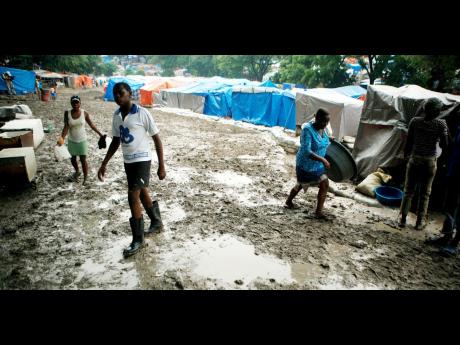
It isn't only hurricanes which have been shuffled over to the backburner. Haiti has been. Following from the January 12 earthquake which killed 300,000 or more people and left more than 1.5 million homeless, Haiti is potentially facing another mass crisis with the onset of the hurricane season predicted to be one of the wettest on record. Prime Minister Jean-Max Bellerive told the Associated Press, "We don't need a hurricane to have problems in Haiti, we just need three or four days of continuous rain to have serious problems." And those rains are coming. Already the moderate spring rains descending on Port-au- Prince are leaving camp residents knee-deep in dirty water. Dr Jean Pape, one of the country's leading public-health experts, who survived the earthquake, has estimated that merely one per cent of the hundreds of thousands of displaced people now living in tents and under tarpaulins in dangerous flood zones have been relocated.
Assistance needed
Haiti needs our continued assistance after our distinguished performance in the immediate post-earthquake relief effort. Our own former prime minister, P.J. Patterson, has been appointed CARICOM's point man for engaging the reconstruction of Haiti. One of the institutions with which I am affiliated, the University of Technology, is on stand-by to apply its technical capacity to the process and has already sent a staff member, Delwin Ferguson, from the School of Public Health and Health Technology, to assist in the initial relief effort.
Our problems seem so small, so manageable, when compared to Haiti's. While we continue beating upon ourselves about the quality of our systems, we have a world-class Office of Disaster Preparedness and Emergency Management (ODPEM), which has now got hurricane preparation and response organised down to a 't'. After years of complacency brought on by the absence of hurricanes, the population, pushed by several years of intense hurricane activity, is now very hurricane savvy. Building practices have responded to hurricane damage. Although squatting in flood-prone areas continues to be a major challenge, loss of life and damage to property from hurricanes have been dramatically reduced.
In 1933, so The Gleaner Geography and History of Jamaica records, a flood of record intensity, occurred in Kingston and lower St Andrew, August 14-15, killing 53 people and destroying more than 300,000£ of property. The flood, coming as the result of weeks of heavy rains, saw the gullies running through the Liguanea Plains overflowing their banks, the banks ripped away and bank dwellers drowning in their swept-away houses.
Bustamante's 'Gully Government' of the 1940s brought those gullies under control and no similar catastrophe has since overtaken the city of Kingston sitting on the Liguanea Plains. Similar civil works across the country have provided considerable protection from the ravages of hurricanes, natural phenomena over which we have no control.
In the necessary rehabilitation which must be undertaken when the garrisons, following Tivoli, have been neutralised, the authorities could learn from ODPEM about organisational efficiency on a shoestring budget and about agency networking to get things done.
Climate change, whatever is causing it, and we won't get into that debate today, is almost certainly behind hurricanes acting up.
The Colorado State University hurricane team has upped its forecasted numbers based on the "continuation of unusually warm tropical Atlantic sea surface temperatures", a Reuters report said, because "warmer waters contribute to the development of hurricanes."
Leading role
Since the 1972 Stockholm Conference on the Human Environment, the United Nations has played a leading role in environmental preservation. The Stockholm Declaration said, "A point has been reached in history when we must shape our actions throughout the world with a more prudent care for their environmental consequences. Through ignorance or indifference, we can do massive and irreversible harm to the earthly environment on which our life and well-being depend. Conversely, through fuller knowledge and wiser action, we can achieve for ourselves, and our posterity, a better life in an environment more in keeping with human needs and hopes. To defend and improve the human environment for present and future generations has become an imperative goal for mankind."
But things have not gone as well as the declaration had optimistically hoped. Human action, for example, may be highly responsible for the global warming, which is blamed for causing climate change, which is generating more hurricanes, and more powerful ones.
And as humankind continues to guzzle petroleum, which powers modern industrial civilisation, while producing massive amounts of greenhouse gases, the Reuters report on the hurricane season went on to say, "the expected extreme hurricane season this year is seen as posing a threat to efforts to control and clean up oil spewing from a ruptured Gulf of Mexico well - described by President Barack Obama's administration as the worst environmental disaster in US history. Experts warn that a storm surge in the Gulf of Mexico - could whip the oil slick and chemicals used in trying to disperse it out of the Gulf and ashore on beaches, vegetation and even homes."
For some years now, the UN Environmental Programme has been publishing a regular Global Environment Outlook (GEO). The most recent, GEO4, says very bleakly that, while there has been some progress on some of the more straightforward problems for which solutions are proven, like the pollution of air and water, there remain persistent problems like climate change, deterioration of fisheries, and the extinction of species. There are no major issues raised in Our Common Future, the report of the 1987 Bruntland Commission on Environment and Development for which the foreseeable trends are favourable. And this may threaten humanity's very survival, the report warns ominously.
Martin Henry is a communications consultant. Feedback may be sent to medhen@gmail.com or columns@gleanerjm.com.